
 English
 中文简体
中文简体 Español

Ice Cream Paper Cup: Designing Packaging for Extreme Cold and High Moisture Conditions
Content
- 1 Understanding the Real Challenges of Ice Cream Packaging
- 2 Material Engineering: Why Paperboard Selection Is Critical
- 3 Barrier Coating Design: The Core Performance Layer
- 4 Structural Design Focus: Where Failures Usually Occur
- 5
- 6 Cold-Chain Compatibility and Filling Line Performance
- 7 Printing Stability in Freezer Conditions
- 8 Compliance and Export Readiness
- 9 Sustainability from a Practical Manufacturing View
- 10 Conclusion: Ice Cream Paper Cups as an Engineered Product
Viewing Ice Cream Paper Cups from a Manufacturer’s Engineering Perspective
From a manufacturing standpoint, an ice cream paper cup is not a generic disposable container but a functional packaging system designed to perform under some of the most demanding conditions in food service: freezing temperatures, continuous moisture exposure, fat migration, and long cold-chain storage.
When we design and produce ice cream paper cups for brands and OEM clients, every material choice and structural detail is driven by one core question:
Can the cup maintain integrity, safety, and appearance from filling to final consumption?
Understanding the Real Challenges of Ice Cream Packaging
Ice cream presents three simultaneous challenges that ordinary paper cups cannot handle reliably:
1.Low-temperature stress
Paper fibers become more brittle at freezing temperatures, increasing the risk of cracking or deformation.
2.Continuous moisture exposure
Melting ice cream creates prolonged internal condensation, which can weaken untreated paperboard.
3.Fat and sugar penetration
Dairy fat and sweeteners can migrate into paper fibers, causing softening, odor absorption, and leakage.
An ice cream paper cup must be engineered specifically to address all three.
Material Engineering: Why Paperboard Selection Is Critical
From the production side, we typically use high-density virgin paperboard ranging from 230 GSM to 350 GSM, depending on cup size and intended use.
Key considerations include:
Fiber length and tightness for structural rigidity
Uniform thickness to ensure consistent forming
Food-contact safety and odor neutrality
For export markets, FSC-certified paperboard is often required to meet both sustainability and brand positioning goals.
Barrier Coating Design: The Core Performance Layer
The inner coating defines whether a paper cup succeeds or fails in ice cream applications.
Commonly Used Barrier Structures
Single PE coating: Suitable for short holding times and quick consumption
Thick PE coating: Preferred for retail ice cream and freezer storage
Double PE coating: Used when extended shelf life and maximum leak resistance are required
PLA or water-based coatings: Applied selectively for eco-focused projects after performance testing
From a manufacturer’s perspective, coating weight consistency is critical—uneven coating leads directly to leakage complaints.
Structural Design Focus: Where Failures Usually Occur
Most ice cream paper cup failures occur in three structural zones:
1.Side seam – must be heat-sealed with precise temperature control
2.Bottom seal – requires full bonding without air gaps
3.Rim curl – provides rigidity and protects against deformation during handling
Our production tolerances are designed around these weak points, with routine leak testing and compression testing during quality control.
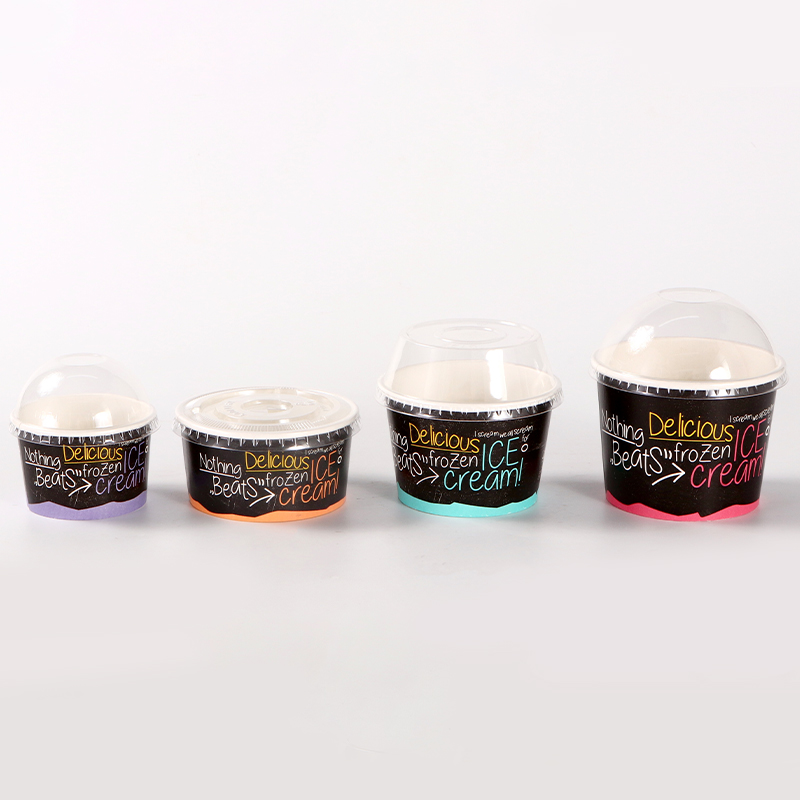
Cold-Chain Compatibility and Filling Line Performance
Ice cream paper cups must remain stable not only during consumption but also during:
Automatic filling on high-speed production lines
Shock freezing after filling
Long-term frozen storage
Transportation through cold-chain logistics
Cup geometry, taper angle, and bottom thickness are adjusted to ensure:
Smooth cup release from filling machines
Reliable stacking without collapse
Consistent portion volume
These factors directly affect operational efficiency for ice cream producers.
Printing Stability in Freezer Conditions
From an OEM perspective, printing for ice cream paper cups requires cold-resistant inks and varnishes.
Standard inks may:
Crack at low temperatures
Lose gloss due to condensation
Transfer color when stacked in freezers
For this reason, we select printing systems that maintain color integrity and brand appearance even after prolonged freezer exposure.
Compliance and Export Readiness
For international buyers, ice cream paper cups must meet strict regulatory standards, including:
FDA food contact compliance (USA)
LFGB and EC 1935/2004 (EU)
Migration testing for coatings and inks
As manufacturers, we ensure full traceability of raw materials and provide supporting documentation for customs clearance and audits.
Sustainability from a Practical Manufacturing View
While sustainability is increasingly important, ice cream applications demand realism.
We advise buyers to balance:
Compostability goals
Actual barrier performance
Local waste management infrastructure
In many cases, optimized PE-coated paper cups with reduced material weight offer a more reliable and scalable solution than underperforming alternatives.
Conclusion: Ice Cream Paper Cups as an Engineered Product
From a manufacturing and OEM perspective, an ice cream paper cup is a precision-engineered packaging component, not a commodity.
When designed correctly, it:
Protects product quality
Reduces leakage and customer complaints
Supports efficient production and logistics
Reinforces brand value in frozen environments
By approaching ice cream paper cups through engineering logic rather than surface-level cost comparison, brands gain a more stable, scalable, and professional packaging solution.
Custom Packaging Made Easy
From concept to delivery, our team ensures your custom packaging needs are met with efficient communication and professional service.
-
 01
01
Briefing
-

-
 02
02
Material & Structure
-
-
 03
03
Artwork & Printing
-
-
 04
04
Sampling
-
-
 05
05
Testing & Approval
-
-
 06
06
Production & Delivery
-
-
Suzhou Accum Packaging Co., Ltd.
Contact us
TEL: +86 512 6378 6312 TEL: +86 182 6183 5029 Add: Zhujiabang, Zhenze Town, Wujiang District, Suzhou city, Jiangsu Province, China -
Quick Link
Home Products About Us Solutions News Contact Us -
Products Links
Paper Cup Paper Container Retail Shelf Packaging Paper Tray Paper Bucket Accessory Latest Stainless Bottle -
News
The Complete Round Paper Bowl Buying Guide for Home and Business Use Paper Cup Holder: How to Pick the Right One Without the Guesswork Why Does My Paper Straw Get Soggy So Fast? (And Other Paper Straw Questions Answered) -
Mobile
