
 English
 中文简体
中文简体 Español

Cup Sleeves Explained: Types, Sizes, Custom Options, and How to Pick the Right One for Your Business
Content
- 1 What Is a Cup Sleeve and Why Does It Matter?
- 2 Types of Cup Sleeves You'll Actually Encounter
- 3 Cup Sleeve vs. Double Wall Cup: Which One Should You Use?
- 4 Custom Cup Sleeves as a Branding Tool
- 5 How to Make Sure Your Cup Sleeve Actually Fits
- 6 Eco-Friendly Cup Sleeves: What to Look For
- 7 Where to Buy Cup Sleeves: Retail, Wholesale, and Custom
- 8 Tips for Getting the Most Out of Your Cup Sleeves
- 9 The Bottom Line on Cup Sleeves
What Is a Cup Sleeve and Why Does It Matter?
A cup sleeve is the corrugated or solid band that wraps around the outside of a hot beverage cup to protect your hand from the heat. If you've ever grabbed a coffee to go and slipped that cardboard ring around your cup before walking out the door, you've used one. Simple as the concept sounds, cup sleeves play a surprisingly important role in the coffee shop experience — they protect customers, reduce the need for double-cupping, and offer businesses a powerful branding opportunity on a small but highly visible canvas.
Beyond the basic function of heat protection, coffee cup sleeves have evolved into a serious marketing tool. From indie cafés printing their logo on kraft paper sleeves to global chains running seasonal sleeve campaigns, this small piece of packaging carries more weight than most people realize. Whether you're a business owner evaluating your packaging options or a consumer curious about what goes into your daily coffee ritual, understanding cup sleeves fully is more useful than you might expect.
Types of Cup Sleeves You'll Actually Encounter
Not all cup sleeves are the same. They differ in material, construction, and purpose, and each type has a specific set of advantages depending on the use case. Here's a breakdown of the most common types available on the market today.
Corrugated Paper Cup Sleeves
This is the most widely used type — the classic ridged cardboard sleeve you see at virtually every coffee chain. The corrugated middle layer traps air between the ridges, creating effective insulation without adding much bulk. These sleeves are lightweight, inexpensive to produce in bulk, and easy to stack and store. They're typically made from recycled paperboard, making them one of the more eco-friendly options available. The corrugated texture also gives the sleeve a grip advantage, making the cup easier to hold even for customers with wet or cold hands.
Solid Paperboard Cup Sleeves
Solid sleeves are made from a single flat layer of paperboard without any corrugation. They're thinner and smoother than corrugated versions, which makes them a better surface for high-quality full-color printing. Businesses that prioritize sharp branding and detailed artwork often prefer solid sleeves because the flat surface allows ink to sit more evenly, resulting in crisper logos and more vibrant colors. The trade-off is slightly less insulation compared to corrugated designs, though for many drinks and ambient temperatures, this difference is negligible.
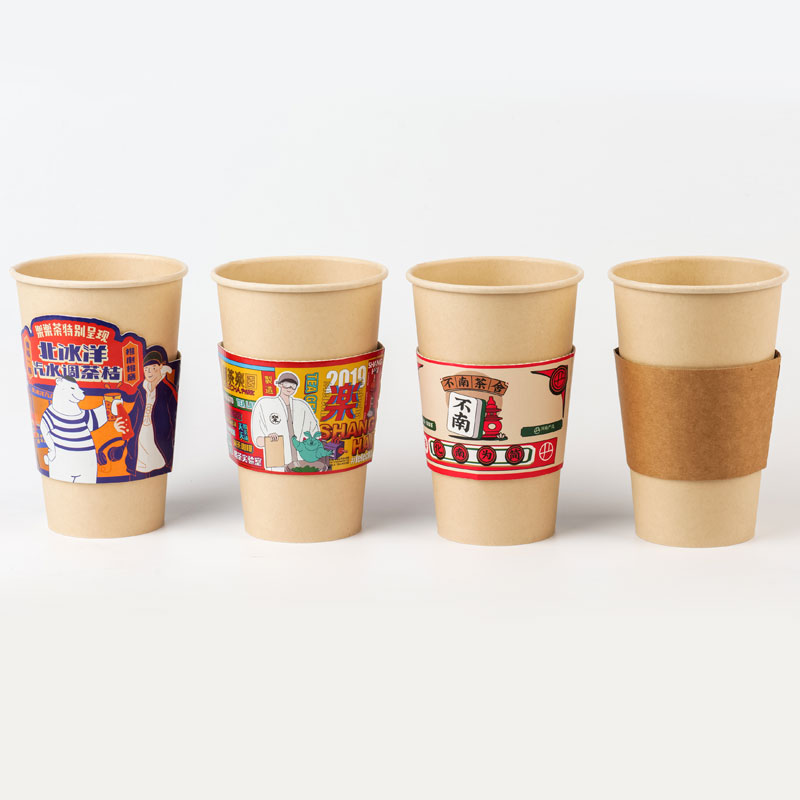
Kraft Paper Cup Sleeves
Kraft sleeves have a natural brown, unbleached appearance that has become closely associated with artisan coffee culture and eco-conscious branding. They're typically made from unbleached recycled fibers and are often 100% compostable. Many independent coffee shops and specialty roasters choose kraft sleeves specifically because the earthy aesthetic communicates sustainability and craftsmanship. They work well with simple one- or two-color logo prints and pair naturally with other kraft or recycled packaging elements.
Reusable Silicone Cup Sleeves
Silicone sleeves are a reusable alternative designed for customers who bring their own cups or use café-branded reusable cups. They stretch to fit a range of cup sizes, provide excellent heat and cold insulation, and are dishwasher safe. While silicone sleeves aren't typically used as disposable packaging in high-volume coffee shops, they're popular as branded merchandise, loyalty gifts, or retail products sold at the counter. They last for years and represent a long-term brand touchpoint with loyal customers.
Cup Sleeve vs. Double Wall Cup: Which One Should You Use?
One of the most common decisions businesses face when setting up their hot drink packaging is whether to use single wall cups with sleeves or invest in double wall cups that don't need a sleeve at all. Both approaches have real-world trade-offs worth understanding before you commit to one or the other.
| Feature | Single Wall Cup + Sleeve | Double Wall Cup (No Sleeve) |
| Upfront Cost | Lower per cup | Higher per cup |
| Total Material Cost | Cup + sleeve combined | Cup only |
| Branding Space | Sleeve + partial cup | Full cup surface |
| Insulation | Good (sleeve-dependent) | Very good (built-in) |
| Service Speed | Slightly slower (adding sleeve) | Faster |
| Storage Space | Need space for both | One item to store |
| Eco Profile | More total material used | Less total material |
For high-volume operations where speed matters and storage is limited, double wall cups often make more sense despite the higher unit cost. For businesses that want to use sleeves as a distinct, swappable branding element — for example, running seasonal sleeve designs without changing the cup — the sleeve-based approach offers more flexibility at a lower cost per update.
Custom Cup Sleeves as a Branding Tool
Custom printed cup sleeves are one of the most cost-effective branding investments a coffee business can make. Unlike printed cups, which require larger minimum orders and longer lead times, custom coffee cup sleeves can often be ordered in smaller quantities and switched out more frequently. This makes them ideal for seasonal campaigns, limited-edition collaborations, event promotions, or simply refreshing your look without overhauling your entire packaging line.
The sleeve travels with your customer. It's seen on the commute, in the office, on social media — every time someone sets down their cup on a desk or posts a flat-lay photo, your branding is right there in the frame. This ambient, organic visibility is something traditional advertising can't replicate, and it costs a fraction of the price.
What to Put on Your Custom Sleeve
When designing a custom cup sleeve, it's tempting to cram in as much information as possible. In practice, less is more. The most effective sleeve designs focus on a few key elements:
Logo and brand name: Should be the dominant visual element, legible at arm's length
Brand colors: Consistent with your other packaging and signage for instant recognition
A short tagline or message: Optional, but a clever line can make the sleeve memorable and shareable
QR code: Links to your menu, loyalty app, social media, or a seasonal campaign page
Sustainability message: If your sleeve is compostable or recycled, say so — customers appreciate transparency
Minimum Orders and Lead Times
Most sleeve suppliers offer custom printing starting at around 500–1,000 units for digital print runs, and 5,000+ units for offset or flexographic printing. Digital printing is more cost-effective at lower quantities and allows for multiple design variants in a single order. Offset printing delivers superior color accuracy and is better suited for large runs where per-unit cost needs to come down. Lead times typically range from 10 to 25 business days depending on the printing method, so plan well ahead of any promotional launch dates.
How to Make Sure Your Cup Sleeve Actually Fits
One of the most frustrating and easily avoidable problems businesses encounter is ordering sleeves that don't fit their cups properly. A sleeve that's too loose slides off; one that's too tight won't go on at all. The fit depends on two key measurements: the cup's diameter at the sleeve zone (typically the lower third of the cup body) and the cup's taper angle.
Most standard sleeves are designed to fit industry-standard cup sizes, but cup dimensions can vary slightly between manufacturers. Always request physical samples from both your cup supplier and your sleeve supplier and test the fit before placing a large order. If you're sourcing both from the same supplier, this compatibility check is usually handled for you — another good reason to consolidate your packaging purchasing where possible.
Standard Sleeve Size Compatibility
Small sleeves: Typically fit 8 oz cups — suited for espresso drinks and small coffees
Medium sleeves: Designed for 10–12 oz cups — the most common café size
Large sleeves: Fit 14–16 oz cups — used for large lattes, Americanos, and filter coffees
Extra-large sleeves: For 20–24 oz cups — popular in American-style coffee chains and convenience settings
Some sleeve suppliers offer universal or adjustable designs that can span two cup sizes, which is helpful for businesses serving a range of drink sizes with a single sleeve SKU. This simplifies inventory and reduces waste from overstocking specific sizes.
Eco-Friendly Cup Sleeves: What to Look For
Sustainability has become a genuine purchasing criterion for many coffee drinkers, and cup sleeve choices are increasingly scrutinized alongside cups and lids. The good news is that paper-based cup sleeves are among the most recyclable pieces of disposable coffee packaging available — far easier to recycle than lined paper cups, because sleeves typically have no plastic coating or lining.
When evaluating the environmental credentials of a cup sleeve, look beyond the material itself to how it was produced and what happens to it after use. Here are the key certifications and claims to look for:
FSC or PEFC Certified: Confirms the paper used comes from responsibly managed forests where trees are replanted and ecosystems are protected
Made from recycled content: Look for post-consumer waste (PCW) percentages — 80–100% PCW is excellent
Recyclable or compostable: Most plain paper sleeves are kerbside recyclable; those made with PLA or plant-based binders may be industrially compostable
Printed with soy or water-based inks: Traditional petroleum-based inks can interfere with composting and recycling; soy-based inks are a cleaner alternative
Minimal or no adhesive: Some sleeve constructions use glue at the overlap joint; water-soluble adhesives are preferable for recyclability
If your business is working toward a net-zero or zero-waste target, publishing the environmental credentials of your sleeve directly on the sleeve itself is a simple way to communicate your values at the point of consumption — right when the customer is most engaged with your brand.
Where to Buy Cup Sleeves: Retail, Wholesale, and Custom
The right purchasing channel depends on your volume, customization needs, and budget. Here's a practical guide to the main routes available to businesses of different sizes.
Retail and Small Quantity Purchases
Small cafés, pop-up stalls, or home bakers selling drinks at markets can find plain corrugated or kraft sleeves through restaurant supply stores, Amazon, or catering wholesalers in packs of 100–500 units. These are unprinted and available immediately, making them a practical stopgap while you arrange custom-printed versions or while your business is still finding its footing on volumes.
Wholesale Purchasing for Established Businesses
Once your weekly cup volume exceeds a few hundred, buying sleeves through a packaging wholesaler or food service distributor brings the per-unit cost down significantly. Wholesale suppliers typically sell in case quantities of 500–2,000 sleeves and offer accounts with credit terms, which helps with cash flow. Many also offer own-brand or white-label sleeve options that are cheaper than full custom print runs.
Custom Printing Suppliers
For full custom-printed coffee cup sleeves, you'll work directly with a packaging printer or a specialist cup and sleeve supplier. Many of these operate online with self-service design tools, allowing you to upload your artwork, choose your material, select your quantity, and get an instant quote. If you have specific requirements — unusual sizes, premium finishes like spot UV or foil, or certified sustainable materials — working with a specialist is worth the slightly longer lead time and higher minimum order.
Tips for Getting the Most Out of Your Cup Sleeves
Even the best-designed cup sleeve won't deliver its full value if it's handled poorly in store or sourced without a clear strategy. These practical tips help businesses maximize both the functional and marketing potential of their sleeves.
Train baristas to position the sleeve so the logo faces outward consistently — it seems minor, but it makes a real difference to how your brand appears in customers' hands and photos.
Store sleeves flat in a dry location away from moisture, as humidity can cause corrugated sleeves to soften and lose their shape, making them harder to apply quickly during a rush.
Use sleeve changes as a marketing moment — announce seasonal sleeve designs on social media and encourage customers to share photos, turning a packaging update into a community engagement campaign.
Consider offering branded reusable silicone sleeves as a loyalty reward or retail item — a customer who uses your sleeve on their reusable cup is advertising your brand every time they use it.
Audit your sleeve waste periodically — if sleeves are regularly being discarded unused or applied to the wrong cup size, it signals a mismatch in your sizing or inventory management that's quietly costing you money.
The Bottom Line on Cup Sleeves
A cup sleeve might look like a throwaway detail, but it's actually one of the most versatile and cost-effective packaging elements a beverage business can work with. It protects your customers, differentiates your brand, and — when chosen thoughtfully — supports your sustainability goals. Whether you're using plain kraft sleeves to keep costs down or investing in fully custom-printed designs with eco-certified materials, the key is to treat the sleeve as a deliberate part of your customer experience rather than an afterthought.
As packaging expectations continue to rise among consumers, the businesses that get the details right — including something as simple as a well-designed, properly fitted, responsibly sourced coffee sleeve — are the ones that build lasting brand loyalty, one cup at a time.
Custom Packaging Made Easy
From concept to delivery, our team ensures your custom packaging needs are met with efficient communication and professional service.
-
 01
01
Briefing
-

-
 02
02
Material & Structure
-
-
 03
03
Artwork & Printing
-
-
 04
04
Sampling
-
-
 05
05
Testing & Approval
-
-
 06
06
Production & Delivery
-
-
Suzhou Accum Packaging Co., Ltd.
Contact us
TEL: +86 512 6378 6312 TEL: +86 182 6183 5029 Add: Zhujiabang, Zhenze Town, Wujiang District, Suzhou city, Jiangsu Province, China -
Quick Link
Home Products About Us Solutions News Contact Us -
Products Links
Paper Cup Paper Container Retail Shelf Packaging Paper Tray Paper Bucket Accessory Latest Stainless Bottle -
News
Paper Cup Holder: How to Pick the Right One Without the Guesswork Why Does My Paper Straw Get Soggy So Fast? (And Other Paper Straw Questions Answered) Paper Soup Container Explained: Sizes, Lids, and Storage Tips You Should Know -
Mobile
