
 English
 中文简体
中文简体 Español

How Ice Cream Paper Cups Differ from Other Disposable Cups
An ice cream paper cup looks deceptively simple, but it faces a unique combination of stresses that most disposable cups never encounter. Ice cream is served at temperatures between 0°F and 10°F (-18°C to -12°C), which causes rapid condensation to form on the exterior of the cup. At the same time, the fat and sugar content of ice cream — along with toppings like hot fudge, caramel, or fruit compote — can penetrate unprotected paperboard within minutes. A cup that cannot handle cold temperatures, moisture, and dairy fats simultaneously will soften, warp, or leak before the customer finishes their serving.
Purpose-built paper ice cream cups use heavier-gauge paperboard, specialized interior coatings, and reinforced base seams to handle these conditions. They are also designed with a wider opening-to-depth ratio compared to beverage cups, making them easier to scoop into and eat from with a spoon. Understanding these structural differences helps you evaluate products accurately rather than simply defaulting to the cheapest option available.
Content
- 1 Wall Construction Options for Paper Ice Cream Cups
- 2 Interior Coatings: What Keeps Ice Cream from Soaking Through
- 3 Standard Sizes for Paper Ice Cream Cups and What Each Suits
- 4 Lid Options for Paper Ice Cream Cups
- 5 Custom Printed Ice Cream Paper Cups: Making Your Brand Visible
- 6 Eco-Friendly Paper Ice Cream Cups: Sorting Real Sustainability from Greenwashing
- 7 How to Test and Select the Right Ice Cream Paper Cup Before Bulk Ordering
Wall Construction Options for Paper Ice Cream Cups
The number of walls in a paper ice cream cup determines its insulation performance, exterior condensation, and overall rigidity. Each construction type suits a different service scenario.
Single-Wall Paper Ice Cream Cups
Single-wall cups are made from one layer of coated paperboard and represent the most affordable entry point for disposable ice cream packaging. They perform adequately in fast-turnover settings where customers eat immediately at the counter or table. The main limitation is condensation — a single-wall cup filled with frozen ice cream will become damp on the exterior within a few minutes, which makes it slippery to hold and uncomfortable for extended eating. For in-store service with a high customer turnover rate, single-wall paper ice cream cups are a practical and cost-effective choice, especially when paired with a napkin or paper sleeve.
Double-Wall Paper Ice Cream Cups
Double-wall construction uses two layers of paperboard separated by an air gap that acts as insulation. This significantly reduces exterior condensation, keeps the cup dry and comfortable to hold for longer periods, and adds structural rigidity that prevents the cup from collapsing under the weight of dense, hard-packed ice cream. Double-wall paper cups for ice cream are the preferred choice for takeout, delivery, events, and any service format where the customer will be holding the cup for more than a few minutes. The higher per-unit cost is offset by a noticeably better customer experience.
Poly-Coated Paperboard Tubs
Wider, tub-style ice cream paper containers with a flat rim and a press-on lid are used for pre-packaged or to-go portions. These are thicker and more rigid than cup-style formats and are commonly used for single-serving take-home portions, catering events, and ice cream delivery services. The flat rim design makes them compatible with tight-fitting lids that prevent freezer burn when stored.
Interior Coatings: What Keeps Ice Cream from Soaking Through
The coating on the interior surface of a paper ice cream cup is what prevents moisture and dairy fats from penetrating the paperboard. Different coating materials have different performance profiles, environmental implications, and cost points.
PE (polyethylene) coatingis the most widely used interior lining for disposable ice cream paper cups. A thin PE film is heat-laminated to the interior — and often the exterior — of the paperboard, creating a smooth, grease-resistant, and moisture-proof barrier that handles frozen dairy products reliably. PE-coated ice cream cups are durable, cost-effective, and available from virtually every packaging supplier. The trade-off is that PE lining makes the cup non-recyclable in standard curbside programs because the plastic film cannot be separated from the paper fiber during recycling processing.
PLA (polylactic acid) coatingis a bioplastic derived from corn starch or sugarcane that is used as an eco-friendlier alternative to PE. PLA-coated paper ice cream cups are certified compostable under ASTM D6400 and can be processed at industrial composting facilities. PLA performs well at cold temperatures and is fully suitable for frozen dessert applications. It does not have the heat tolerance limitation that makes it unsuitable for hot beverages, so it is a strong choice for ice cream cups specifically. If your business participates in a verified industrial composting program, switching to PLA-coated ice cream cups is a meaningful sustainability upgrade.
Wax coatingis an older coating method that uses food-grade paraffin or soy wax to waterproof the paperboard. Wax-coated paper cups have a slightly matte, waxy feel and are commonly associated with traditional-style ice cream parlors. They are compostable and do not contain plastic, but they offer less grease resistance than PE or PLA and may allow slow penetration from high-fat ice cream toppings over extended hold times. Best suited for immediate consumption rather than take-home or delivery use.
PFAS-free aqueous coatingsare water-based barrier coatings used in environmentally positioned products as a replacement for both plastic linings and fluorinated grease-resistant chemicals. They offer moderate moisture resistance and are free from per- and polyfluoroalkyl substances (PFAS), which are persistent environmental contaminants found in some older food packaging coatings. For dry or semi-dry frozen desserts with minimal sauce or topping contact, PFAS-free aqueous coatings perform adequately, though they are less robust than PE or PLA for heavily sauced sundaes or liquid-topped servings.
Standard Sizes for Paper Ice Cream Cups and What Each Suits
Ice cream paper cups are sized by fluid ounce capacity, but because ice cream is denser than liquid, the practical serving size in weight will always be less than the stated volume. A 12 oz paper cup will typically hold around 5–6 oz of ice cream by weight when filled to a reasonable level with one or two scoops. Here is a practical sizing guide:
|
Cup Size |
Capacity |
Typical Scoops |
Best For |
|
Mini |
3–4 oz |
1 small scoop |
Tasting portions, kids' samples, event samples |
|
Small |
6–8 oz |
1–2 scoops |
Kids' menu, light dessert portion |
|
Medium |
12 oz |
2–3 scoops |
Standard serving, sundaes with toppings |
|
Large |
16 oz |
3–4 scoops |
Loaded sundaes, premium servings |
|
Extra Large |
32 oz+ |
5+ scoops |
Sharing portions, catering, party servings |
When choosing a size, always account for toppings and sauces added after the base scoop. Hot fudge, caramel sauce, whipped cream, and sprinkles can easily add 1–2 oz of volume on top of the ice cream itself. A cup filled to the very rim is difficult to transport without spilling, so build in at least half an inch of headroom above your intended fill line.
Lid Options for Paper Ice Cream Cups
Not every ice cream service requires a lid, but for takeout, delivery, and pre-packaged portions, the right lid makes a significant difference in product quality and customer satisfaction. Ice cream cup lids fall into several categories, each suited to a different application.
Flat press-on lids are the most common choice for take-home and delivery ice cream. They press down firmly over the rim of the cup and create a tight seal that prevents freezer burn and protects against contamination. Flat lids are compatible with stacking, making them practical for pre-packaged portions in display freezers. They are available in clear PET or PP plastic for visibility, or in paper-based versions for eco-aligned operations.
Dome lids add vertical clearance above the rim of the cup, making them ideal for ice cream cups where whipped cream, a cherry, or tall toppings extend above the cup opening. Dome lids protect the presentation during transport while keeping everything contained. They are commonly used for premium sundaes and specialty dessert cups where visual presentation is part of the product experience.
Spoon-slot lids have a small, pre-cut slot that allows a spoon or small flat spoon to pass through the lid without removing it. This is particularly useful for self-serve frozen yogurt or gelato stations where customers pick up their portion and walk around before sitting down. The slot keeps the lid in place and prevents toppings from shifting while still allowing the customer to eat directly from the cup.
No lid (open top) is perfectly appropriate for in-store service where the customer sits down immediately. Lids add cost and material waste, so eliminating them for dine-in portions is a straightforward way to reduce per-serving cost and packaging footprint without affecting the customer experience.
Lid compatibility is not universal across manufacturers. Even cups with identical stated fluid ounce capacities from different suppliers can have slightly different rim diameters, causing lids to fit loosely or not at all. Always source lids from the same supplier as your cups, or confirm exact rim diameter measurements before mixing products from different sources.
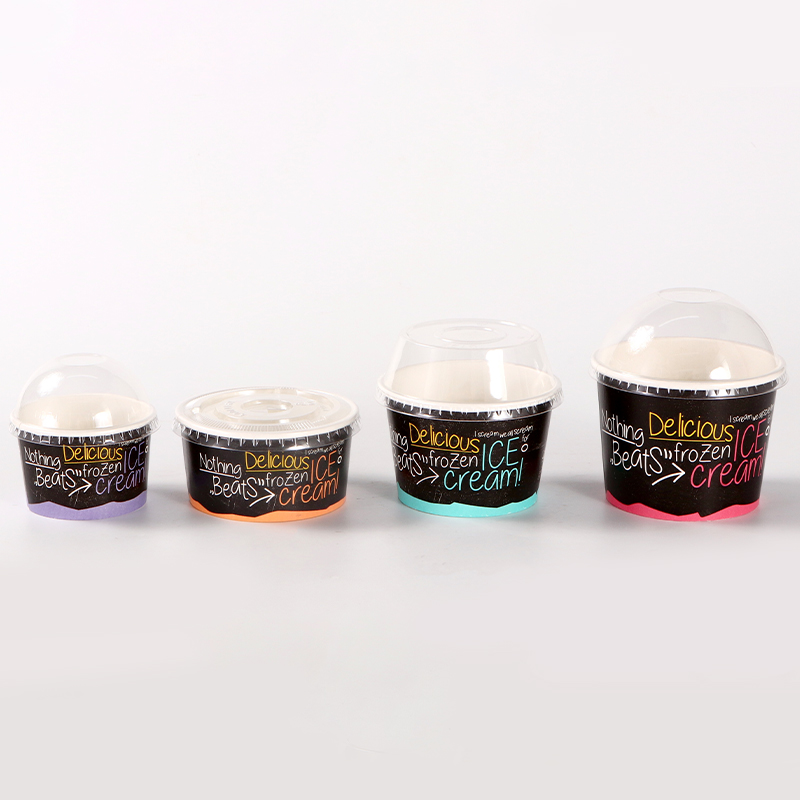
Custom Printed Ice Cream Paper Cups: Making Your Brand Visible
Custom-printed paper cups for ice cream are one of the most visible branding investments a frozen dessert business can make. Every cup that leaves your shop carries your logo, color scheme, and design into the street, onto social media, and into customers' memories. A well-designed cup reinforces brand identity and increases the perceived quality of your product.
Print Methods by Volume
The right printing method depends on how many cups you need and how complex your design is. Flexographic printing is the standard for large runs — typically 10,000 units or more — and delivers consistent, vibrant results at the lowest per-unit cost. It requires the creation of printing plates for each color, which adds an upfront setup fee but becomes negligible at high volumes. Digital printing suits shorter runs of 500 to 5,000 units, has no plate setup cost, and handles complex designs with gradients or photographic elements well, though the per-unit cost is higher than flexo. For very small operators who cannot meet the MOQ for direct print, a custom-designed paper sleeve fitted around a stock cup is a low-cost alternative that requires no minimum order.
Practical Design Guidelines
Keep your primary logo and brand name in the upper half of the cup where it remains visible when the cup is held in a hand or placed in a holder. The lower third of the cup is frequently obscured.
Choose colors that photograph well under both natural and artificial light. Ice cream cups are frequently photographed for social media, and colors that look flat or washed out on camera undermine the premium feel you are trying to create.
Always request a physical die-line template from your supplier before submitting final artwork. The vertical seam of a paper cup runs along one side and can bisect a design element if artwork is not laid out with the seam position accounted for.
Consider whether your lid should coordinate with the cup. A branded cup paired with a plain clear lid looks professional, but a lid printed with your brand color or a simple logo takes the presentation to a noticeably higher level at a modest additional cost per unit.
Eco-Friendly Paper Ice Cream Cups: Sorting Real Sustainability from Greenwashing
Sustainability is a growing concern for ice cream businesses, particularly as customers and regulators pay closer attention to single-use packaging. The market is full of products labeled as eco-friendly, natural, or green, but these terms have no standardized definition and can be applied freely by any manufacturer. Here is how to evaluate claims accurately.
|
Claim |
What It Actually Means |
How to Verify |
|
Compostable |
Breaks down in industrial composting; not suitable for home compost piles |
BPI Certified (ASTM D6400) |
|
Recyclable |
Most coated paper cups are not accepted in curbside recycling due to plastic lining |
Confirm with your local materials recovery facility |
|
Plant-based |
Coating is derived from plant sources (PLA); does not automatically mean compostable |
Ask for BPI certification to confirm compostability |
|
FSC Certified |
Paper sourced from responsibly managed forests; addresses raw material, not end-of-life |
Check for FSC Chain of Custody certificate number |
|
PFAS-Free |
No fluorinated chemicals used; relevant for grease-barrier coatings in food contact packaging |
Request a written PFAS-free declaration from the manufacturer |
For ice cream businesses looking to make a genuine environmental impact, the most effective strategy combines PLA-coated cups with a verified industrial composting program at your facility or through a third-party waste management partner. Without the composting infrastructure in place, even a certified compostable ice cream cup will end up in landfill, where it breaks down no faster than a conventional cup.
How to Test and Select the Right Ice Cream Paper Cup Before Bulk Ordering
Committing to a large bulk order of ice cream paper cups without proper testing is a risk that can result in wasted budget, service disruptions, and customer complaints. Run through this evaluation process with physical samples before placing your first large order with any supplier.
Fill and hold test.Scoop your standard ice cream portions into the sample cup, add your typical toppings and sauces, and hold the cup bare-handed for ten minutes. Check whether the exterior becomes damp or soft, whether the base seam shows any signs of moisture penetration, and whether the cup remains rigid and comfortable to hold.
Hot topping test.If you serve hot fudge, caramel sauce, or other warm toppings over ice cream, pour a measured amount of the hot topping over a scooped cup and observe how the cup material responds. The bottom of the cup should remain firm and the coating should show no signs of softening, wrinkling, or separation where the hot topping contacts the cup wall.
Lid fit test.Apply your intended lid to the sample cup after filling. The lid should snap on securely without requiring excessive force and should not pop off when the cup is tilted at a 45-degree angle or gently squeezed on the sides. A loose lid is a spill hazard and a poor customer experience.
Freezer storage test.For pre-packaged or take-home portions, fill and lid several sample cups and place them in your freezer at your standard storage temperature for 24 hours. After removing them, check that the paperboard has not warped, the seams have not separated, and the lid has not contracted away from the rim due to temperature changes.
Stack and storage test.Stack 20 to 30 empty sample cups to verify they nest cleanly without jamming or collapsing. Measure the height of the stack against your counter dispensers or storage shelves to confirm they will fit your existing setup without modification.
Custom Packaging Made Easy
From concept to delivery, our team ensures your custom packaging needs are met with efficient communication and professional service.
-
 01
01
Briefing
-

-
 02
02
Material & Structure
-
-
 03
03
Artwork & Printing
-
-
 04
04
Sampling
-
-
 05
05
Testing & Approval
-
-
 06
06
Production & Delivery
-
-
Suzhou Accum Packaging Co., Ltd.
Contact us
TEL: +86 512 6378 6312 TEL: +86 182 6183 5029 Add: Zhujiabang, Zhenze Town, Wujiang District, Suzhou city, Jiangsu Province, China -
Quick Link
Home Products About Us Solutions News Contact Us -
Products Links
Paper Cup Paper Container Retail Shelf Packaging Paper Tray Paper Bucket Accessory Latest Stainless Bottle -
News
Why Does My Paper Straw Get Soggy So Fast? (And Other Paper Straw Questions Answered) Paper Soup Container Explained: Sizes, Lids, and Storage Tips You Should Know What Is a Single Wall Paper Cup? A Simple Guide Anyone Can Understand -
Mobile
